How to improve candidate engagement for total talent acquisition

Employers put a great deal of time and energy into candidate engagement. Even in a slower hiring market, where many roles attract more applicants than recruiters can review, candidate expectations remain high.

Yet our latest research shows that effort isn’t translating into a better candidate experience. In PeopleScout’s Inside the Candidate Experience 2026 report, featuring data from a global survey of more than 1,000 job seekers across 10 markets, just 11% of candidates rated their experience as very positive, down from 18% in 2023. Ghosting was a big part of the problem, with 64% of candidates hearing nothing back from more than half of the employers they applied to. Employers that want better outcomes across their hiring programs need to rethink how they engage candidates.

That challenge grows when permanent and contingent hiring run as separate processes, because candidates can have very different experiences depending on the type of role they apply for. Organizations are starting to close the gap. Everest Group research shows nearly half of enterprises are now actively working to unify their permanent and contingent hiring strategies. With economic uncertainty continuing and many employers relying on contingent talent to respond to shifting demand, that work is becoming more pressing. A total talent acquisition strategy, encompassing both full-time and contingent  hiring, can help organizations reduce agency costs and fill the roles the business needs most.

In this article, we’ll look at how siloed permanent and contingent hiring affects the candidate experience, share best practices that work across both worker types, and explain what to look for in a total talent partner.

A tale of two candidate journeys: permanent and contingent workers

Permanent hiring typically involves thorough vetting, with recruiters responsible for moving candidates through the process. Contingent hiring often includes more stages and handoffs as suppliers pass candidates to hiring managers, and it’s sometimes decentralized, with each department managing their own hiring.
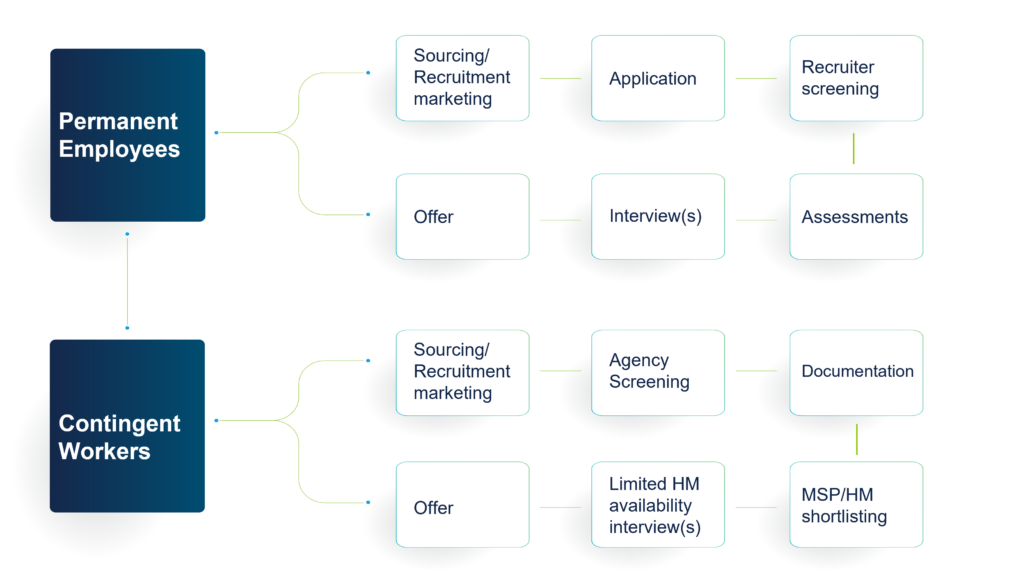
Recruitment process workflows for both permanent employees and contingent workers

Ownership is split, too. Typically, procurement leaders oversee contingent labor spend, while talent acquisition leaders look after full-time hiring. As a result, a candidate applying for a permanent role and a contractor applying for a temporary assignment at the same organization may go through entirely different processes, with different contacts, timelines, and levels of communication.

The importance of a total talent acquisition strategy

To the business, the need is usually simple: hire the right talent to get the work done. Recruitment, however, usually isn’t organized that way. As the two journeys above show, permanent and contingent hiring often run as separate processes. When both sides compete for the same talent pool, the costs can add up.

  • Both sides may pay a premium to reach the same candidates.
  • Each side may advertise, source, and screen for similar roles separately.
  • A strong candidate turned down for a permanent role often isn’t considered for a contract assignment—the same is true in reverse. In both cases, talent you’ve already paid to attract is lost.

The cost can also extend well beyond the hiring program. In our 2026 research, 37% of candidates who had a negative experience said they would tell others not to apply, and 36% said they would stop buying from the company. For consumer-facing businesses with large contingent workforces, a poor experience for one group of workers can quickly become a brand reputation problem.

A total talent acquisition strategy brings permanent and contingent hiring together under one view of demand. Organizations can start with the work that needs doing and then find the best route to the right talent, rather than deciding first whether a role should go to an employee or a contractor. Just as important, every candidate gets a consistent experience of your brand, however they come to you. That consistency is the foundation for better candidate engagement.

How to improve engagement for every candidate

So, how do you create an engaging candidate experience that gives both full-time and contingent candidates what they want? The fundamentals are largely the same, whatever the worker classification. In our 2026 research, candidates ranked respect for their time (4.36 out of 5), a transparent process (4.28), and fair assessment (4.27) as the most important parts of the hiring journey. In practice, that means holding contingent hiring to the same standard as full-time recruitment.

Let candidates drive the process

Wherever possible, candidates should be able to move themselves through the hiring process, whether they’re applying for a permanent position or a three-month contract. Self-service steps like mobile applications, text-based screening, and automated interview scheduling can reduce the friction that leads to drop-off. For contingent workers—who are often on tighter timelines and evaluating multiple immediate opportunities—speed and self-service are crucial to securing top talent before a competitor does.

Focus on your candidates, not your company

Start by thinking about the specific talent personas you’re targeting. Your recruitment marketing campaigns and job postings should feature thoughtful messaging that highlights what’s in it for them. A contractor may care most about pay transparency, speed to placement, project scope, and flexibility, while a permanent candidate may focus more on career growth, culture, and benefits. Tailoring your messaging helps both groups feel understood.

Make your career site work harder for you

Your career site is often where candidates decide whether to apply at all, yet contract roles may only be advertised through staffing suppliers. Unifying your career site to showcase both permanent and contingent opportunities helps reduce confusion.

Ensure the site is easy to navigate and eliminates duplicate postings. For example, a retailer hiring full-time and part-time seasonal staff across multiple locations should make it clear whether applying to one role opens consideration for others. Adding FAQ content that outlines the application process for both permanent roles and contingent assignments gives every applicant confidence upfront.

Streamline interviews

The shelf life of an engaged candidate is short. While permanent roles typically involve thorough, multi-stage vetting, contingent hiring often gets bogged down by multiple handoffs between staffing suppliers and internal department managers. Match your interview stages to the role type. Using pre-recorded video interviews or automated scheduling tools helps you connect with candidates quickly, preventing contractors and full-time applicants alike from getting lost in scheduling delays.

Keep candidates informed at every stage

Our research found communication was one of the weakest-performing parts of the candidate experience. While TA teams often have automated communication set up for permanent hires, contingent candidates rely on staffing suppliers to keep them updated, and standards can vary widely from one supplier to the next. A few best practices can help:

  • Set clear expectations about timelines and next steps at the point of application.
  • Deploy automated status updates by text and email, and set the same communication standards for your staffing suppliers.
  • Close the loop with every candidate, including contract workers who weren’t selected. A contractor who isn’t the right fit for one assignment could be exactly the talent you need for the next.

candidate engagement for contingent workers

Build pathways between contingent and permanent roles

A total talent approach works best when talent can move between worker types. A contractor who performs well on assignment already knows your organization, your teams, and the work, which can make them a strong candidate for a permanent role.

Direct sourcing can make those moves easier. Rather than relying on staffing suppliers to find talent for each role, you use your existing talent database to build and engage talent pools for both permanent and contingent roles. Those pools can include former employees and contractors, referrals, and strong runners-up from past searches. Because these candidates are already familiar with your organization, you can often fill roles faster.

Three steps can help you get started:

  • Keep talent pools engaged between roles with regular, relevant communication, so candidates stay connected to your brand until the next opportunity opens.
  • Give contractors visibility of permanent openings and a clear route to apply.
  • Track contractor performance so hiring managers can identify strong candidates for permanent roles.

Choosing a total talent partner for better candidate engagement

Executing a unified recruitment strategy across talent acquisition and procurement, two functions that have historically worked separately, isn’t easy. Coordinating technology, aligning processes, and shifting organizational mindsets often require specialized expertise. That’s why many organizations choose to work with a total talent partner.

When evaluating a partner to help achieve your total talent goals, three things matter most.

  • Dual-market expertise: Look for a partner with a clear view of both permanent and contingent hiring along with demonstrated success in your specific labor categories. They should have the market intelligence required to map candidate personas across both talent pools to effectively identify, engage, attract, and retain talent.
  • A unified tech stack: Your partner should offer talent technology that balances sourcing, AI, and automation to move candidates smoothly through the funnel—regardless of worker classification—while keeping candidates informed and ensuring humans remain in control of every hiring decision.
  • Customized total workforce solutions: A partner should create a solution unique to your business, combining approaches like direct sourcing, internal mobility, and employer branding to bring your permanent and contingent talent strategies together.

total talent acquisition solution

See how this works in practice

When a global food manufacturer brought permanent and contingent hiring under one total workforce strategy with PeopleScout, it filled about 40% of staffing requests the same day and cut compliance deficiencies by 91%. Read the case study.


Contingent Workforce Solution Opens the Door to a $500K Cost Savings & a Total Talent Solution

Contingent Workforce Solution Opens the Door to a $500K Cost Savings & a Total Talent Solution

MSP for Manufacturing

Contingent Workforce Solution Opens the Door to a $500K Cost Savings & a Total Talent Solution

PeopleScout helped a leading door and window manufacturer achieve a $500K cost savings within twelve months of launching an effective MSP program. Plus, PeopleScout introduced Recruiter On-Demand™ to support an increase in demand for permanent recruitment, as part of a total talent solution.

1,500 Annual contingent hires
$ 500,000 Dollars in cost savings in the first year
250 Full-time hires over 11 months

Situation 

PeopleScout has partnered with this door and window manufacturer since 2017, providing Managed Service Provider (MSP) support for contingent talent solutions in the areas of light industrial, technology and professional roles. Initially, PeopleScout supported locations in the U.S. only, but in 2021 expanded into Canada, playing a key role in supplier vetting, contract negotiations, data collection and manager and supplier trainings.  

The organization was also having challenges filling full-time roles, providing the opportunity for PeopleScout to supplement their contingent staffing support with our Recruiter On-Demand™ solution.

Solution

Over the course of this partnership, PeopleScout’s MSP team has made several technology and process improvements, including a vendor management system (VMS) transition, streamlined documentation requirements, a new approach for managing and improving supplier performance, and a candidate experience assessment.

The team also collaborated with PeopleScout’s Recruiter On-Demand™ (ROD) team to conduct a discovery session to understand the primary areas of increasing demand for full-time roles. Together, the teams developed and implemented an ROD strategy, focused on ten primary locations. The ROD solution included a daily applicant tracker for client visibility into the talent pipeline, and marketing and employer brand support. PeopleScout’s recruiters sourced qualified candidates, who were then interviewed by the client’s hiring managers.

The candidate experience assessment, conducted by PeopleScout’s technical solutions architects, identified opportunities to improve the look and feel of the organization’s careers site, particularly to appeal more to full-time candidates.

Results

The updates PeopleScout has made to the client’s technology and documentation processes have eliminated administrative burdens on both suppliers and hiring managers. The MSP solution achieved cost savings of more than $500,000 in the first year alone.

PeopleScout also seamlessly integrated a Recruiter-On-Demand™ program to support full-time hiring needs, as part of a total talent solution for the door and window manufacturer. The ROD program generated 250 hires over just 11 months across the selected 10 locations.

At a Glance

  • COMPANY
    Door and Window Manufacturer
  • INDUSTRY
    Manufacturing
  • PEOPLESCOUT SOLUTIONS
    Recruitment Process Outsourcing, Managed Service Program, Total Talent
  • ANNUAL HIRES
    1,500 contingent hires and 250 full-time hires
  • LOCATIONS
    U.S. and Canada

The Skills Crisis Countdown: The Clock is Ticking on Tackling Skills Gaps

The Skills Crisis Countdown: The Clock is Ticking on Tackling Skills Gaps

Our latest research reveals, nine in 10 HR leaders believe that up to 50% of their workforce will need new skills to perform their jobs in the next 5 years. Yet, only 7% say they are actively investing in reskilling programs, and 45% admit to having no plans to undertake a workforce transformation initiative to prepare for the changing skills landscape.

PeopleScout partnered with skills-based workforce management company Spotted Zebra to survey over 100 senior Human Resources and Talent Acquisition leaders from organizations around the global and 2,000+ employees globally to compare perspectives on workforce skills. The resulting research report, The Skills Crisis Countdown: The Clock is Ticking on Tackling Skills Gaps, provides a detailed picture of the current skills landscape and the disconnects between the perspectives of employees and businesses.

Download our free report for the latest research exploring:

  • The current state of skills in the global workforce and outlook for the future
  • How HR leaders are preparing for the impending skills crisis
  • How employees expect their skills will need to adapt to new technology or automation.

Plus, you’ll get a roadmap of actionable steps to help your organization become more skills-centric.

Inside the Candidate Experience 2023

Inside the Candidate Experience 2023

The Hard Truth About Candidate Expectations vs Candidate Experience Realities

The candidate experience has never been more important. Yet, the latest research from PeopleScout shows that less than two in 10 candidates would rate their recent recruitment experience as excellent.

We audited the candidate journey of over 215 organizations around the world, giving each a Candidate Experience Quotient (CandidateXQ) score—a calculation based on 40 key experience indicators, including 15 critical factors that make or break the candidate experience.

By analyzing these CandidateXQ scores alongside data gathered from surveying over 2,400 job seekers globally, we uncovered a clear disparity between candidate expectation and reality.

Download our free Inside the Candidate Experience report for the latest research exploring:

  • What candidates expect at each stage of the journey and how employers stack up
  • Where each industry is succeeding or struggling with candidate experience
  • Actionable steps you can take to improve your CandidateXQ

Destination 2030: 10 Predictions for What’s Next in the World of Work 

Destination 2030:

10 Predictions for What’s Next in the World of Work

The last few years have been tumultuous for talent acquisition leaders, and it doesn’t look as if the pace of change is going to let up. Are you looking for ways to future-proof your workforce and create a resilient talent strategy?

Buckle up and join us as we travel to the world of work in 2030! Our ebook, Destination 2030, explores the latest research and global workforce trends and how they might impact the way we work.

In this ebook, we explore:

  • Demographic changes in the workplace and how to engage each generation
  • The changing role of technology in candidate and employee engagement
  • Our top 10 predictions for what’s next in world of work

[On-Demand] Boosting Candidate Engagement with a Comprehensive Talent Strategy

[On-Demand] Boosting Candidate Engagement with a Comprehensive Talent Strategy

The current hiring environment remains a challenge for employers—in the U.S., there are currently 4.3 million more open jobs than there are job seekers. Not only are employers struggling to find enough qualified candidates, keeping them engaged proves even more critical amid rising trends like candidate ghosting and recruitment process drop-out as well as the continued Great Resignation.

To cope, many organizations have added more gig workers, but the market for contingent workers suffers the same challenges. If talent leaders aren’t leveraging a unified strategy for recruiting both full-time employees and gig workers, gaps in their workforce will persist.

So, how can you engage these different types of candidates? Join PeopleScout Global Vice President of Implementation Mark Fita for the newest Talking Talent webinar, Boosting Candidate Engagement with a Comprehensive Talent Strategy, available now on-demand.

In this webinar, Mark will cover:

  • Today’s candidate recruitment process landscape
  • Best practices for optimizing your recruiting process
  • How to expand your employer brand to gig workers
  • The importance of using the right technology to engage candidates
  • And more!

Total Workforce Solutions: A Holistic Approach to Talent Channel Management

Modern workforce management has evolved. Increasingly, organizations are leveraging a multi-channel approach for sourcing talent to extend the reach of both their internal and external workforce. In fact, evidence of this trend can be seen in a survey conducted by the MIT Sloan Management Review, which found that 87% of global executives included some portion of external workers (contingent workers, contractors, freelancers and statement of work [SOW] consultants) when considering their workforce composition. 

And, because employers are leveraging multi-channel sourcing strategies, workforce management programs are more complex – thereby resulting in the need for new strategies, proven methodologies and enhanced levels of service from outsourced providers. So, in this article, we’ll discuss how a Total Workforce Solution (TWS) can help your organization by providing a holistic approach to total talent management through enhanced strategic capabilities; precise and up-to-date workforce information; and greater visibility into the multi-channel workforce.

What Are Talent Channels?

A talent channel is a managed and repeatable source of talent and may include anything from a job board to staffing vendors and college campuses. Essentially, a talent channel is a dependable path that leads job-seekers to your open positions.

Just as marketers utilize a variety of marketing channels and techniques to acquire customers, talent professionals likewise need to utilize various talent channels to attract prospective job candidates. And, while there are a host of recruitment channels and platforms to choose from, below we’ve outlined some of the most common and effective sources:

  • Job Boards: Job boards (including generalist and specialist websites) – where recruiters and organizations post open positions – have long been a source of candidates. More recently, job aggregators like Indeed have provided an alternative platform where job-seekers can search and apply for jobs. 
  • Internal Recruitment: Internal recruitment offers many benefits. For example, internal talent pools already have a wealth of knowledge about the company, the company culture and expectations. Therefore, directly sourcing and redeploying candidates who are already within the organization can also dramatically decrease time-to-hire, as well as hiring costs associated with training and onboarding.  
  • Campus Recruiting: Campus recruiting has been a mainstay for recruiting the next generation of young talent for years. Campus recruiting involves sourcing, engaging, and hiring college talent for internships and entry-level positions, while also building a talent pipeline for an organization’s future hiring needs.
  • ATS Database: An organization’s Applicant Tracking System (ATS) is an invaluable resource for sourcing and curating top talent. An ATS offers a recruiting channel full of applicants who may not have been the best fit for one position, but who have the experience and skills needed for a current or future opening. 
  • Events: Whether you host career events or attend networking opportunities, the power of face-to-face interactions with candidates is priceless. And, although in-person meetings have been less likely lately due to the pandemic, many organizations are still leveraging virtual events to meet and engage with candidates. 
  • Employee Referrals: Employee referrals are an effective way to build a talent pool because they allow employees to submit candidates from their professional and personal networks for open roles. Plus, by encouraging referrals, employers can tap into a steady flow of candidates, while also providing additional opportunities for engagement and compensation for current employees.
  • Staffing Vendors: Organizations might also outsource certain recruitment functions to staffing vendors to curate talent pools and supply candidates. Staffing vendors help organizations with permanent placement, executive search, SOW contracting and procuring talent of all categories – both permanent and contingent.

Sometimes, a hiring or procurement manager may fill an open role from a certain talent channel and labor type simply due to historical practices or for budgeting reasons. However, a Total Workforce Solution model opens the possibilities for reassessing historic practices and identifying the most efficient labor category and talent channel to deliver better outcomes.

Why Total Workforce Solutions Are Perfect for Workforce Management

workforce management

Total Workforce Solutions – also known as Total Talent Solutions and Total Talent Acquisition – are outsourced programs that blend the capabilities of Recruitment Process Outsourcing (RPO) and Managed Service Provider (MSP) programs by integrating the talent acquisition function for permanent and contingent workforces under one delivery team. By bringing together disparate talent functions under one centralized program, Total Workforce Solutions provide organizations with greater visibility for all workers, including full-time employees and contingent workers (such as temporary workers, independent contractors, freelancers and SOW providers). Total Workforce Solutions also provide a holistic view that leads to better workforce, sourcing channel, and demand management by deploying the resources, technology, and strategies best suited to improve talent and business outcomes. Specifically, a TWS offers:

Data Capture & Analysis: A TWS can take unstructured workforce management data from multiple sources and formats and create structured outputs, which create greater visibility into an organization’s workforce and talent channel efficacy. This enables an organization to measure the success of each recruiting channel, as well as employer brand campaigns and staffing vendor performance.

Resource & Process Control: The right workforce management view helps ensure the right work is being done by the right type of worker. Thanks to the holistic view provided by a Total Workforce Solution, organizations can track how budgets, headcount, procurement, staffing vendors and other issues are being managed across the entire enterprise.

Talent Engagement Expertise: Understanding the talent market is key to knowing how to best attract and engage job-seekers across all labor categories. To that end, a TWS provider’s ability to engage with job-seekers in both full-time and contingent sourcing channels in ways that job-seekers want to be engaged is driven by expertise in candidate experience and engagement. What’s more, TWS providers also have dedicated resources to support education and adoption of the best practices among an organization’s hiring managers and other stakeholders; this ensures that talent teams are engaging candidates from all talent channels in the right way.

Single Point of Contact: While procurement, HR, and talent teams each have their own methods, talent channels, and hiring objectives, each department strives to secure talent to meet their organization’s business needs. Fortunately, Total Workforce Solutions can help successfully align talent acquisition strategy across each of an organization’s recruitment channels by communicating between HR, recruiting and procurement teams. In this way, the TWS ensures that the right talent decisions are made for wider business goals, thereby optimizing both permanent and contingent workforces to give you a total talent view.

Workforce Management: Leveraging Talent Channels to Plan Ahead

In the dynamic talent environment created by the pandemic, employers are finding it increasingly difficult to source talent. Even so – and despite persistent hiring challenges – organizations need to be smart about the allocation of talent acquisition resources when filling roles. For example, conversations about filling open roles should begin with fundamental questions, like: What do we need to accomplish? Is the role easily managed with clearly defined goals? Is it core to the organization’s long-term strategy? Does the role require a long-term commitment, project ownership and management?

Depending on the answers to those questions, you can determine whether a full-time employee or a contingent worker is the best option. And, understanding how to more effectively fill or augment talent gaps also allows teams to scale, prioritize and be nimble – each important factors in today’s business climate.

Furthermore, different talent channels will have different advantages and disadvantages to consider. But, a TWS provider can provide insights by identifying all available sourcing channels, as well as assess where work needs to be done and what skills are needed to get it done. Then, from this evaluation emerges a talent strategy that taps into available candidates from across an organization’s recruitment channels – which then provides a high level of precision for getting the work done with the highest-quality output at the most cost-effective rate.

Candidate & Hiring Manager Experience

In talent acquisition, the human element matters. Specifically, an empowered experience on the part of workers who feel they have access to more opportunities can help boost an organization’s employer brand across its talent channels, as well as among job-seekers and the general public. At the same time, a positive experience for a hiring manager who has access to all talent types equates to higher engagement from the manager, including an increased commitment to sourcing talent from the right talent channels and at the right time and cost to achieve the desired goals.

Furthermore, the traditional employer brand is built on the idea of the employee value proposition that seeks to answer, “Why would this company be a great place to work?” And, to appeal to the growing, flexible workforce, the concept of the Assignment Value Proposition (AVP) is gaining ground as a fundamental brand component to support cases in which an organization needs to sell the value of the project just as much as the strength of the business itself. Add to this assignment value the idea that an organization provides many ways to work – through traditional employee roles or flexible assignments – and the result is a reputation that appeals to professionals of all working preferences.

Fortunately, a TWS provider can help you create compelling employer value propositions across your talent channels so you can attract the right mix of external workers and traditional employees. In particular, a TWS provider will have discussions with your team to consider the following in relation to messaging:

  • Work: Role versus project type and required necessity of skill; core versus non-core
  • Speed: Time to fill, time to contract, time to productivity and leveraging known relationships to reach candidates
  • Cost: Expected tenure of salary plus benefits or rate; or pay rate plus mark-up or deliverable and milestones
  • Worker Engagement: Classification preference or mandates, talent motivation, and talent communication

This discussion will provide you with insights into delivering precise and sophisticated messaging to job-seekers regardless of talent channel, as well as create better recruitment marketing for talent sourcing, engagement and management activities. Moreover, a TWS provider with a firm understanding of your workforce needs that is supported by the right talent technology and committed to continuous improvement will bring the value of a holistic view into your talent channels and workforce strategy. As a result, your organization will be able to make better data-driven decisions and broaden your choices from a single note to a full orchestra of talent options. While the journey takes time and dedication, the effect of this approach – in terms of access to talent, speed of engagement, cost control, and alignment of talent and business strategy – makes the effort essential for growth in today’s competitive global business environment.